Showing posts with label RASA. Show all posts

Wednesday, 23 November 2022

FREEDOM CHALLENGE/ RASA Summer 2022 by: Craig Bosenberg

 FREEDOM CHALLENGE/ RASA Summer 2022


Introduction:


In early 2020, as the COVID pandemic began to grip the world, I was on a medical school class reunion Whatsapp and one of my old friends from University mentioned that he was doing a bike race across South Africa. This looked interesting and after “watching” him traverse the country as a “dot” on a computer screen, I thought that this event, the Freedom Challenge, would be something Id like to do someday. I pencilled it in to my “post retirement” bucket list.


Fast forward 18 months of COVID and I was becoming increasingly frustrated with the “sterile” life I had been living thanks to lockdowns and mask mandates. A lack of events had meant that my fitness had declined and I had put on weight. I needed a project and something to train and look forward to. I floated the idea of taking on the Freedom Challenge with my wife and she supported me. I then fortuitously stumbled into a situation at work where I was able to take a year off from my regular long hour and high stress job to focus on training for the event. The stars were aligning. When I finally floated the idea to an old friend of mine from University who now lived in New Zealand and he unexpectedly immediately jumped at joining me on the adventure, the die was cast and I entered.


After 9 months of fairly single minded prep, training and research, I lined up on 17th October at 6am at the city hall in Pietermaritzburg ready for the challenge.


I entered hoping to traverse the country of my youth on my bike. I knew the trail would take me through some of the most beautiful parts and I was looking forward to this.. I wanted to challenge myself physically and mentally and I knew the event should provide this. More importantly though, I wanted to have an adventure. After 2 years of COVID restrictions, I wanted to feel alive again. 


What I got fulfilled these ambitions, but so much more and in a more profound way. I have been off the trail now for over 2 weeks and not a day goes by that I don’t think about the experience. Many have described this journey far more eloquently than I will ever be able to, but what follows is my feeble attempt at putting in words my own personal journey.


Background:

The Freedom Challenge is a truly unique MTB adventure which follows the Freedom Trail. This is a route devised by Dave Waddilove through some of the most remote Wilderness areas, private and public lands of South Africa, from East to West showcasing the diverse Flora and Fauna of South Africa as well as her people. 


Technically it is a “self supported” MTB “Race” with the aim being to finish in the shortest possible time. Various time Cut offs ensure that one has to keep moving down the trail. The race record is 10 days, the final cut off is 26 days.


Somewhat interestingly, one may not use GPS and navigation is with 1:50000 maps and a compass. The maps are provided before hand and most participants spend a considerable amount of time studying them and comparing them to images of google earth before the race.


Whilst one is expected to be fully self sufficient and able to repair and maintain one’s own bicycle and carry one’s own gear, the race is unique in that there are “support Stations” which are places every 50-100kms along the trail. These support stations are places where the people living there have agreed to provide a bed, a shower and food to any cyclist arriving there should they need it. These support stations range from a few hotels/ B and Bs to Farms where the private farmers have agreed to provide this service and a village where the villagers give up their own beds to the cyclists (and also a couple of “Self serve” support stations where there are beds and food, but one is left to one’s own devices.) These supports stations are integral to the event.


In addition, one can send 20 2litre “ice cream” containers to a number of these support stations before hand with supplies which one can collect along the way. Most participants use these containers to store their maps for the next leg, as well as snacks and energy bars. Occasional bike spares and first aid paraphernalia are also placed in strategic containers. Interestingly, the event has a fairly high attrition rate and one of the “Rules” is that if one leaves the event, the contents of one’s ice cream containers is available to anyone who is still on the course. This means that later support stations, for those still riding, are highly anticipated not just for the station support, but also for the treats one might find in one of scratched rider’s containers.


Finally, during the race, one is tracked with a “Spot” tracker and one’s progress is followed by a dedicated group of “dot watchers” from previous challenges and one’s own family and friends. The tracker is supposed to update every few minutes, but is somewhat temperamental and this , together with watching “dots” leaving the route inadvertently, leads to a surprising amount of tension and excitement for those watching the event from home. A facebook page also provides an avenue for those participating to upload pictures from the trail which adds the engagement.


A dedicated group of supporters of the trail also follow the riders along the trail in the background. This group are called “Buffalo herders” and are only meant to be used for the compulsory escort through the Baviaanskloof.  They are a reassuring anonymous presence that can, and have been called in in emergencies, to help stricken riders. On two occasions in the last Winter Freedom Challenge they very likely saved lives and, in my case, were instrumental in allowing me to continue on in the race.


All finishers receive a Sotho Blanket.


Route:


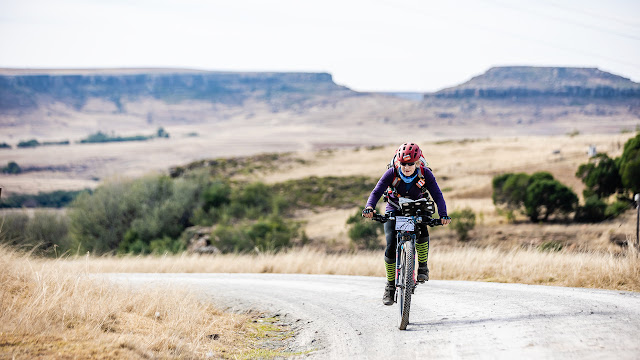
The trail starts in Pietermaritzburg in the Natal Midlands area of South Africa and finishes at Diemersfontein in the Western Cape. In total, it traverses over 2100km and 33000m of climbing. The highest elevation reached is over 2700m.


Almost the entire route is offroad with less than 50km on tar roads. The remainder of the route entails gravel and farm roads, jeep tracks, cattle and game tracks, single track and hiking paths and some areas with no obvious path but a general direction through the bush/ veld.


There are a number of mandatory “hike a bikes” over mountainous terrain.


The route goes through private farms, wilderness areas, game parks and nature reserves as well as a few towns and passes many historic sites along the way. It passes through some of the most remote and most beautiful parts of the country. Outside of the first few days and the last 2, one sees very few people along the way.


The route is insanely beautiful as it passes through one stupendous landscape after another.  From the rolling hills and mountains of Kwazulu Natal to the Streams and valleys of the Swartberg to the planes of the Klein Karoo, to the stunningly beautiful World heritage Baviaanskloof and onto the Western cape, not a single day goes by where one is not surprised by yet another breathtaking Vista. Words and Pictures do not do the scenery justice. Its is truly spectacular.


The Flora and Fauna is also diverse and spectacular. Im not sure there is a Southern African antelope species I did not see on the trail, from the smallest Reedbuck to Eland, Kudu to Giraffe and Buffalo. The birds were also incredible. Owls, Storks and cranes were common as were Weavers and other colourful birds. From the green, lush grasslands of Natal to the arid Karoo, the Flora was incredible.


The designers of the route very seldom take one on the easy route and each day poses different challenges. There are very few straightforward days without some sort of new and unique challenge ranging from river crossings, 7hr portages up the side of mountains, to steep mountain passes and long flat days in the saddle where one is wishing for hills so that one can get off ones bike to give ones legs and butt a break. There are also some unique navigational challenges including the Vuvu/ Lehanas, Bontebok,Elandsberg, Osseberg, Struishoek and Stetyns kloof portages.


The is at once, insane, but also perfect.


People:


One of the richest parts of the Freedom Challenge is the people:


Fellow riders are all, like oneself, just a little crazy to have even contemplated the event, let alone lined up to start it. Every one has there own story, and all are a unique. Its a treat and privilege to get to know them. It feels great to be around people who have the same crazy approach to adventure as oneself and to hear all their unique stories. Some, one only meets fleetingly on the trail, and others one spends many days with, getting to know them and cementing friendships which one has little doubt would last well past the end of the event. My race would have ended had one rider, who was forced to retire, not lent me her seat post. On another occasion, another rider literally saved my life as he pulled me from a flooded river. Everyone looks out for one another. A truly special band of people.


Support station hosts: Its hard to put into words how grateful one is to these folk who open their homes to wet, smelly, muddy strangers and feed them and put them up in their houses for the night (and sometimes more).  Often the strangers only arrive for 30 minutes before moving on. It is huge privilege to stay in these places and to briefly get to know these folk. I loved hearing their stories and perspectives and immersing myself once more in the history of the South African diaspora. It was a hugely positive experience. On the trail one stays in many different accommodations from rooms in farmers houses, to huts in villages to suites in hotels. ALL help create the rich experience of the race. All the hosts and stays are special and stories such that one does not want to leave. The food is delicious.


Buffalo herders and Race Directors: It is hugely reassuring to know these angels are out there, keeping track of ones progress and being available in a crisis. The Buffalo herders also have unique stories and it was great getting to know them as well on the rare occasions when our paths crossed. Their advice was invaluable. I have no idea how Chris got a seat post to me in the middle of the Klein Karoo, but he saved my ride and for that I am truly grateful. I have no idea how Chris and Julia are able to manage the logistics of this event, but Im grateful they do. It’s a truly amazing event.


The People of South Africa: It was so inspiring to ride through the country to see and meet so many positive people. It’s the antidote to the negative press and stories that grace the front pages every day. The joy of the kids as one rides past them, high fiving on the route, or as they run next to you up the hills through the villages was energizing. The helpfulness and positivity of the villagers and farmers as one asked for directions and assistance was a joy. I stopped on more than a few occasions to chat to people along the way as they engaged me on my ride and am richer for it.


Navigation:


One of the unique features of this event is the fact that GPS navigation is forbidden. All navigation is done with a map, a narrative and a compass. The compass is extremely accurate. The map is more or less accurate, but, on occasion is slightly outdated and the narrative is largely accurate, but has some glaring ambiguities which sometimes cause one to make wrong turns if one isn’t careful.


This aspect of the race was the aspect that made me the most nervous going in. I am used to following GPS enabled devices when riding on my own and I wondered if Id be able to follow a map sufficiently well to complete the event. In addition, there are many instances where racers have become severely lost and spent the night sleeping “rough” or had to abandon the race completely. 


Before the event, I therefore studied this aspect fairly carefully and read a book on orienteering. I still lined up fairly anxious that I would find this challenging.


Fortunately, I started with a couple of folks who had done a few freedom challenge events before and got some tips in the early stages from them. This set me up for the rest of the race as I gained confidence in my ability to navigate.


I learned to follow a few important principles:

1)    Always know exactly where one is on the map

2)   Never go down a hill unless one is completely confident one is heading in the right direction

3)   If one makes a mistake backtrack to the point where one last knew one was right.

4)   I always tried to start difficult sections early and tried to avoid ever heading into one in the dark. My reasoning was that if I got lost, I would have lots of time to find my way and if it was dark, the sunrise would help.

5)   Try, as much as possible, to navigate the really tough sections with buddies.


The interesting thing for me about the navigation was that, as opposed to GPS, it forces one to be present in ones environment and to really take note of it and all aspects of it. One has to study the contours of the hills, the streams one crosses and the far off vistas. Everything is a clue. Everything matters. 


I found this mind shift quite profound and it added to my enjoyment of the trail. For sure, progress was slow at times as I was very careful not to screw up.Those who have done the event before have an enormous advantage for those who are competitive in nature, but the pluses of the “forced” engagement with my surroundings was immeasurable. I “get” the reliance on maps and compasses now and would be a strong advocate for keeping this feature, even though, when I lined up for the start, I found this one of the most intimidating and annoying features of the race.


Risk:


By taking on the Freedom Challenge one takes on an element of risk which one does not experience in every day life. This risk can potentially be life threatening and includes: 


1)    Weather- thunder and lightning storms and floods as well as heat: 

a.     My riding mate and I were stuck in a lightning storm on the top of a mountain on one occasion when a lightning strike occurred right above us. Both of us quite seriously told the other to tell our loved ones we loved them if the next strike hit either of us. 

b.     I was swept under bridge after a freak incident when I stepped into a fast flowing stream. I was lucky in that the person I was riding with at the time was standing next to me and was able to assist me in getting out of the river before I got washed under. If Id been washed under the bridge, I hate to think what might have happened.

c.     Many of the rivers we crossed became flooded due to storms and this necessitated the route to be altered in some instances.

d.    We ran out of water on one day when the temperature reached the high 30s in the valley. This led to a very uncomfortable hour of riding. Much more and we could have run into trouble.

2)   Animals- There are a number of potentially deadly animals whose paths we cross

a.     Snakes- Black mambas and Puff Adders both live in areas we traversed. A bite from the former would likely be lethal, the latter would mean a prolonged stay in hospital if help arrived in time 

b.    Predators- fortunately there are no areas where one cycles together with large predators other than Leopards that aren’t known to attack humans. The one area where leopards are extremely prevalent is the Baviaanskloof and this is probably the area where one is almost guaranteed to be riding with someone.

c.     Large game- Buffalo and Rhino are present in some of the parks and reserves one rides through. We saw Buffalo in the Baviaanskloof.

3)   Terrain-

a.     Remoteness- for the vast majority of the adventure, one is many hours from help. Even if one were to hit ones Spot tracker, the most rapid response might take hours. 

b.    Terrain- there are many unrideable parts of the trail and many High consequence parts. In addition, some of the hike a bike sections are over fairly steep cliffs and rock scrambles. A poor choice or moment of inattention could easily lead to a severe injury.

c.      I had three crashes / incidents on the trip, all in innocuous parts of the trail:

                                               i.     I was coming down a trail and crossed a stream in about an inch of water. The rocks were slippery and my tire slid out. I fell down and hit my head and shoulder. Fortunately not severely.

                                             ii.     The previously mentioned bridge incident of being swept under the bridge left me with a knee injury that meant I was practically unable to pedal or walk on my left leg for 12 kms. Fortunately this resolved, otherwise my race would have been over

                                           iii.     I was riding through a field and failed to see a hole. I hit it and went over the handlebars. I was lucky not to injure my wrist or shoulder which were both bruised. It would have been a long wait had I fractured anything

4)   People- South Africa is known for its high crime rate and violent crime statistics.

a.     Most of the trail is through extremely remote areas

b.    Absolutely everyone I interacted with on the trail was extremely positive.


One of the most profound insights from the trail for me was how risk averse the world has become. How perspective is important in assessing risk and how damaging living in a risk free, cocooned environment being fed sensational stories designed to increase ones anxiety by social media is destructive. 


Coming out of COVID, where breathing the same air as someone else, or standing within 6 feet of them was considered risky, it was life affirming to be able to “live” again free of the constraints of social media.


Life isn’t risk free and whilst some might consider the Freedom Challenge a little too risky, there is little doubt that, for me, it helped give me perspective on how assuming some risk in ones daily life, enhances it and allows one to have experience and grow. The risk one assumes is most often far less than the media has driven us to  believe.


Opportunities for growth are often not available without an assumption of some risk.


I rode conservatively and walked many sections that I felt carried some risk of injury. Sections I would ride easily in my normal riding routes in Victoria. I tried to manage my risk as best I could. Despite this, the serious incidents happened in the most innocuous areas of trail. I wouldn’t have been able to avoid these even riding in my back yard.


For sure, I had some anxiety travelling through areas where large game were known to exist alone. BUT, after riding for 10kms through one such area , I turned a corner into a small collection of laborers cottages- a group of 5- 6 year olds were playing in the field next to me as rode through. So whilst the risk I perceived was high, the actual risk was obviously extremely remote as these kids clearly had no concerns and neither did their parents. Everything is relative.


Similarly, upon arriving in Macrgegor, I took a wrong turn and ended up in the “wrong” part of town. Gangsters were clearly part of the fabric of the area I found myself in. After realising I was lost, I approached a couple of men who were obviously past or present gang members given their prison tattoos and general demeanour. I asked them if they could tell me where a certain street was. They couldn’t have been more helpful. 


Again, Im sure that in a different environment, these men might not have been so helpful, but treated with respect, a smile, and a crazy looking dude on a bike,they couldn’t do enough to help me. 


Its easy to believe and listen to narratives which might not be very flattering, but its also important to realise that the vast majority of people have good hearts and are willing to help when given the opportunity and respected. This may be naïve, but I suspect that, this is far more true than many of the negative narratives fueling our modern society.


The Challenge:


The Freedom challenge is an incredible challenge. It requires one to ride/ hike around 12 hours/ day, sometimes longer, for close to 3 weeks. TO be successful, one has to manage eating and fueling. One has to maintain ones bike and prevent it breaking down. One has to manage all the aches and pains that arise and wounds that are inflicted. Despite prodigious amounts of food and calories, I lost 10kgs during my ride.


There is a certain amount of luck required to finish the race and I certainly had my share.


One spends a lot of time outside ones comfort zone, but that’s the point.


It is by far the hardest physical challenge most who take it on will ever experience. BUT the beauty of it is that its actually very accessible and completing it is within reach of almost anyone who can ride a MTB, with a sense of adventure , the right attitude, some determination and some fitness. 


This is the beauty of the Freedom Challenge.


The “racers” don’t go a hell of a lot faster than everyone else, they just do it longer and are able to survive on less sleep.


Arriving at many of the portages, one cannot help but wonder how one will ever manage to get to the top, and yet one just puts one foot in front of the other and eventually one is there. It doesn’t matter how steep or insane the portage, eventually one overcomes it, even if one feels like, at times, one is hardly moving.


The Journey:


By far the most profound part of the Freedom Challenge is the “journey” it forces you to take.


Many describe the event as life changing or life affirming and its easy to see why.


For me personally, the event exceeded my expectations and was far more profound an experience than I ever anticipated:


I started the event with certain goals and schedules in mind. Some of these were forced because of the window I had to complete the event before returning home, but some were self inflicted. I had come to start conservatively, but then also to push myself.


The first week went by in a blur of excitement and felt like any multi day event Id done previously. Challenges were addressed and overcome and I arrived in Rhodes “on target”. Shortly after Rhodes, I experienced my fall under the bridge and injured my leg and a few days after that, my seat post broke. Both of these resulted in me feeling like my race was over. Had it not been for some extraordinary luck, it would have been. At these points in the race, I felt extremely pessimistic and “down”. 


Interestingly , the injury meant that I lost the group I was travelling with at the time as they moved on. This meant that when my knee felt better, I needed to take on a significant portage alone and in the dark. I did this without too much trouble and this gave me the confidence that I could do the race alone if need be.


When my seat post broke, I gave myself up to the trail, as by then I knew I could do it, but would need to be lucky to get my blanket.


This shift meant that from then on, I rode with a less goal orientated approach and rode just to enjoy the trail: For sure, I wanted to get to Diemersfontein within a certain time to get my plane, but my riding become much more mindful. Together with the nav, this meant that my daily experience became far more “pure”. I tried to focus just on being in the moment, in that place. Riding my bike, enjoying the scenery and taking in the experience. Ride, Eat, sleep repeat.  


By the end, I enjoyed riding in my own company. I enjoyed the challenge of Stetyns on my own, but most importantly, I just enjoyed “being”. 


The Freedom Challenge fed my soul.


Getting to the end was bitter sweet as it was great to be finished and have accomplished my goal. It was great to know I would be seeing my family again soon and to chat to my wife and kids. It was a relief that I wouldn’t have to ride my bike the following day….


BUT it also meant that the adventure was over and I wasn’t sure I was ready for it to end just yet. 


Would I do it again someone asked: “ in a heart beat……..”

Monday, 17 January 2022

RASA 2021 Pietermaritzburg to ….. uhm ….. Romansfontein | By: Tracey Lentin

Day 1 started pretty well. I knew I wasn’t as strong as the rest of the group so I set of at manageable pace with plans to skip the lunch stop and get down to the Umko as early as possible. All went well with only a minor issue involving a bull - until I got down to the river. Having not been there in 4 years and never having done the river crossing before, I first went one way to find the crossing, changed my mind and tried to find the original route only to find myself facing a wall of thick bush with monster thorns. It was getting late and I had no intention of sleeping on the banks of the river so, in frustration, I looked for a cattle crossing and waded into the river heading for the settlement on the other side. The river bottom soon disappeared and I found myself swimming and hanging onto my bike for dear life. Trying to drag the bike through rapids on the other side was quite an exercise but all I could think of was the bitch of a climb to come, up Hela Hela (I’d even dreamt of it). A large owl quietly sitting in the middle of the road cheered me up and I finally arrived at Allendale long after dark and with all my kit soaked. 


A late start on Day 2 to dry kit and recover meant staying at Centocow (interim stop). Good nav and an early start on Day 3 and I arrived at Ntsikeni for a fabulous lunch and good catch-up with Dalo Ngobo. I set off for Glen Edward with plenty of time to get through Politique Kraal with it’s tricky nav. A silly error and I found myself above the kraal with a steep gorge between us. I decided it was best to retrace my steps and was really pleased to see Kemsley and Andrew right where I’d made my mistake. They kindly stayed with me until we were on the jeep track heading off the mountain. I made my way down in the dark and, in my excitement, rode right past the support station. I finally arrived to a warm welcome by Charles and sad news about Sheila’s illness (praying she’s soon home safe). It had been a 16 hour day on the bike but I felt good.

Great weather and a good day’s riding with minor issues in the wattles, no problems finding the farm houses in “my” valley and I arrived at Masakala with light to spare. About half an hour later a rowdy bunch of guys arrived. What a pleasure to have such lekka company after spending most of the first 4 days alone. The next 4 days were a bit of a blur with us battling gale force winds and me desperately trying to match the guys pace.

I arrived at Slaapkranz after dark, completely shattered, and decided to call it a day. I sadly informed race office and my support group that I was heading home. I got up early and said goodbye to the guys promising Richard, John and Steve that I would be there to welcome them in at Diemers. They unfortunately pulled out a few days later due to some serious injuries. A good night’s rest and practical advice from the guru MD and I changed my mind and decided to push on after a day’s rest.

I got an early start on Day 10 but careful navigation through the 2 big portages (my 2014 memories were very sketchy) and I soon realised that I was only going to make Moordenaarspoort that day. I was cruising merrily down the steep, rutted road towards the SS in the dark when I was suddenly launched over the handlebars – my backpack propelling me forward like a guided missile. As I lay on the ground I did what any self-respecting woman does and made sure my face was still intact. Luckily I’d landed head first and my helmet and headlamp took the brunt of the fall. Only after I had confirmed that no facial reconstruction was needed did I noticed the pain in my ankle. Luckily it wasn’t far to the support station and I limped in feeling very sorry for myself. A quick confer with Julia (and FC doc) and I was instructed to ice, ice, ice and that my ankle was going to be unstable for portaging. Regina and Danie were amazing and, after the best shower ever, I was feeling a lot better.

I left early for breakfast at Kranskop where I met Gary and RG then headed to Brosterlea for the night. As the wind departed, the cold arrived and I left a freezing Brosterlea before dawn wondering how my ankle would handle the blockhouse portage. A cold start gave way to a stunning, wind free day and I made good time to Romansfontein after carefully descending the steep portage section. I love the gentle cows and bulls one finds in KZN and EC, so different from the vicious bovines poor unsuspecting cyclists have to deal with in the Cape. They were often my only company for most of the day and we had some interesting conversations as one does on the trail.

I arrived at Romansfontein at about 4.30pm knowing that I would have to head on to Hofmeyer 72kms away if I wanted to make the 6am cut-off. Gary arrived soon after and, nursing an extremely painful abscess in his tooth, said that he couldn’t go on. Three other guys arrived and laughed when I suggested possibly going on. I was then faced with the dilemma of going on alone, in the dark with a sprained ankle to attempt a technical portage that was between me and the cut-off. It was pretty much a no-brainer and I accepted that my ride was done. Being told the following morning that the temp at the farm had dropped to -18deg during the night confirmed that I had made the right decision.

I have had some time to unpack my ride and do the whole woulda, coulda, shoulda thing. I have come to the conclusion that you cannot enter RASA with the only goal being to finish and get a blanket. A blanket is an amazing achievement and I’m pretty disappointed that it has once again eluded me but I had an incredible journey. I met wonderful people, saw places most people never get to see and pushed myself beyond what I ever thought I was capable of. I leave the trail a far richer person. Thank you to all my friends and family for the incredible support xx

Tuesday, 24 August 2021

"Peaches!" | by: Oliver Greaves

As I pluck the final Hakea thorn out of my finger, I find myself ready to write this. While out on the trail, I kept reminding myself, during the many hard moments, that “This is type two fun”. As each day passes, I find it easier to forget the hard moments and appreciate the value of the adventure.

Something I have come to love about endurance events, is their ability to challenge one. To an extent, you can decide how hard or how easy you want your experience to be. The groups I found myself in, rode hard each day with the intent to have... READ FULL POST HERE


Tuesday, 17 August 2021

RASA 2021 Daily Voice notes | By: Sandy Inglis

 A collection of daily voice notes as sent by Dr Sandy Inglis to his personal whatsapp followers group during RASA 2021. These wonderfully descriptive narrationstell a beautiful story of his journey accross South Africa. Thanks to Steve Burnett for compiling the voice notes into 4 files (one for each 4-5 day portion) for ease of listening. 


Knowing Your Limits | by: Andrew Cromhout

Knowing Your Limits | RASA 2021


I recently shared Mike Roy’s last report for RASA 2021. It makes some good reading, however I

found the stats most interesting. Needless to say I had some complimentary feedback on my humble

achievement, however one of the comments I received was from a school colleague a year or two

behind me at school. I via return comment suggested that he should be next up for the challenge.

During a conversation at the Rhodes stop over, Mike confirmed that he knew the person from his

East London days, and had also been suggesting to him that he should be doing RASA.

Let me undoubtedly state that the person in question, was, and I am sure still is, a much more

talented or gifted person than I was or will probably ever be. (Physically and intellectually). I was at

best an average sports participant, having achieved some nice milestones, but never really coming

close to the top echelons of my sports activities. I won’t bore you with these; however it is safe to

say I have stretched myself on numerous occasions.

This person’s comment back to me on my suggestion that he participate was “I know my limits”. (I

need to mention he clearly put an emoji next to it with a wink!). That however made me think and

snigger at the same time. The question is this; do we really know our limits? I can quote numerous

sayings that would challenge that statement, however it can also lead to another few discussions. I

will give my humble opinions on two points: -


  1. Firstly and most foremost, and it has been stated more than once before in RASA blogs,

RASA is not for everyone. Whether you are racing the event or a tourist, (completely the

wrong description!), RASA is extremely tough. Hard Core tough! Each day is hard, some days

are easier than others, but still tough. A lot of days are extremely challenging and extremely

tough. Forget about the challenging weather we had at times this year. Even on the most

suitable of days to ride your bike, you are going to dig deep, very deep at times. Memories

are short, but you could dig deeper than you have ever done before. Ask the contenders for

the top place finishers how the race went. They will have done meticulous planning and

preparation, but nothing stops your inner demons from testing you. The same for the

tourists such as me. Whilst I am classed as a “tourist”, having completed the adventure in a

little short of 21 days, I consider myself as a racer. Laugh at me if you will, however I tried

my best and beyond every single day out there. I completed the event in the best possible

time I could. For me, I “raced” RASA. Ask me after the event if I would ever do RASA again,

and I don’t have to give you my comments. At 61, I do think my extreme events may have

come to an end; however my awe of this event urges me to suggest that RASA could be a

sort of pinnacle of an adventure cyclist event for a lot of people.


I would strongly advise that anyone considering doing RASA, and even the individual legs of

The Freedom Challenge, think really hard as to the reasons you want to participate in this

challenging but rewarding “adventure”, as someone who is a podium finisher named the

event to a colleague and me. If you are simply looking for some fun and adventure, I can

suggest lots of other alternatives, which are great fun and adventure activities. Yes, amidst

the at sometimes pain, exhaustion and tough times, there are numerous fun moments. You

will see parts of our country that most people will only see snippets of in their life time. Here

you will experience beauty and sometimes poverty and the simple existence of life, like


others will never see. Stetteyns has to be one of the most beautiful and unspoilt areas I have

been to. Some of the fynbos areas outside McGregor have to belong in God’s back yard.

Flowers, sun birds and sugar birds abound in all sorts of colours, shapes, sizes and sounds.

How the young herders towards the top of Lehanas exist leaves me astounded. These are

memories in my head that don’t need photographs to explain or remind me of.

However, the big warning, RASA is not simply a fun adventure. You must think about your

participation more than over a glass of wine. Think hard and deep, and if your innermost

reasons for wanting to do RASA are compelling enough, what are you waiting for?

Remember, like me a lot of other participants are Mr/Mrs/Miss average, so dare I suggest, if

you have the very strong desire to participate in RASA, you can probably complete it. Yes

you will have to train extremely long hours and hard, (another topic), have a strong mind, be

stubborn at times, tenacious, however the psychological experience you will encounter of

completing it, will only be known to you across the finish line.

The issue of you probably completing RASA does lead to my second opinion though.


    2. Do you really know your limits? REALLY?! I can promise you one thing, I dug deeper than I

have for a long, very long time, and if not the deepest I have ever dug in my life. Yes age is

not my friend anymore, as I stare down my best before and expiry date more regularly. But, I

am unequivocal in my opinion that I grew tremendously during RASA.

I won’t get too religious here, however one of my colleagues during the race suggested that

he knew I my convictions may be slightly religious. That was true, however during and by the

end of RASA, I was way beyond that. There were times on my bike when no one was around,

that I cried with big tears. I shouted into the wind where nobody could hear me. I cried in my

bed. Maybe you don’t relate to the religious part, however I can assure you, at times, your

inner demons will test you beyond measure. If you succumb as many do, as was put to me

by an experienced and podium finisher RASA participant and blogger as I have stated before,

you are possibly normal. (Not judging their personal reasons!) But overcoming those

demons stretches and expands you to new limits. Remember the sayings, you cannot grow

in your comfort zone, and challenge your limits, don’t let your limits challenge you.

The growth I have experienced during RASA is something I could not have imagined. The

growth and bonding my family experienced leaves me speechless. I won’t bore you with the

details, but I can promise you, each and every RASA participant knows what I am talking

about. Not one will challenge my opinion.

So, in closing, I have new limits. Limits I never knew and probably most other people I know,

share the same opinion. They asked why I am doing this. Are you mad? Are you stupid? Have

you forgotten your age? Why? Why, why, why…? You will possibly endure the same

questions, but if like me you have a little rat inside you that needs to be fed with adventure

and adrenalin every now and again, I suggest you strongly check in and see if you really

know your limits? As Nelson Mandela said, “It is impossible until it is done”


(And by the way, does anyone know of a decent rat poison that will sort this rat inside me

out for ever!)


Wednesday, 6 January 2021

Freedom Challenge - RASA 2020


In this beautiful film, two of the stalwarts of the event, Tim James and Mike Woolnough tell us a bit more about what this event means to them and the massive impact it has on the lives of all those who experience the Freedom Trail.
All footage was shot during the 2020 Race Across South Africa in October 2020.
Film by : Andrew Muckart // Sledgehammer Studio

Wednesday, 20 November 2019

Freedom Challenge - (RASA) June 2019 by Andrew Ryan

Freedom Challenge - Race Across South Africa (RASA) June 2019

Finishing RASA in 2017 was a tremendous relief. Ever since watching a documentary on the first RASA on TV I was infatuated with the idea of participating. I would find myself telling friends, “I’m going to do that race someday” but it was never the right time. There never is a right time, one can always find a good excuse not to enter - I can’t afford 3 weeks off work; my daughter’s in matric, and so on. After about 10 years of procrastination, I finally plucked up the courage and managed to “tick the block” finishing 17 days later in Paarl. During the race I had made a wonderful friend in Gavin Robinson, we rode 16 of the 17 days together. “That’s it, it’s done” I told Gina (wife) no need to worry about that one again. “I’m a blanket wearer now I can relax”. Famous last words!

That was 2017, this blog is about the first 8 days of the 2019 race. But first, what draws you back to RASA? Those who have participated know the answer. I have really battled to explain it. All I know is that within a couple months of recovering from frozen fingers and toes in 2017 my mind started wandering straight back to the Freedom Trail. Bizarrely I found myself telling mates that I wanted to go back and do it again, afterwards I would chastise myself “are you nuts? you have your blanket, shut up, why are you putting yourself under pressure again?”. It wouldn’t take more than two beers at a braai and I would start thinking about it, talking about it, dreaming about it, feeling like I really really had to go back. I would lie awake at night thinking about the route, clicking through the support stations: Allendale, Centocow, Ntsekeni, Glen Edward, Masakala, Malekgolonyane, Tinana, Vuvu … as if I was counting sheep! Eventually I would envisage myself arriving at Diemersfontein outside Paarl looking thin and feeling happy. My mind would then wander to the navigation…….turn left after the school, don’t forget to get a coke at that spaza, look for the bokkie sign, fill your bottle here, jump the fence there, look for the windmill, eventually drifting restlessly off to sleep having gone through the entire route in my mind but not before thinking about what I would do better and what kit I would take next time. What next time? If I need another damn blanket, I’ll bloody well buy one at Pep! 

But the Freedom Challenge addiction eventually won. I couldn’t be satisfied with one blanket I needed two. I have two children, each must have a blanket! Late in 2018 I took the plunge again and entered but not before I had persuaded my good mate Renier van der Merwe (Van) to join me for his first race and oh yes, I also convinced poor Gavin back for his third (he has 3 children ;). My plan was for us to knock it off in 15 days at worst 16. I knew I could take a day off 2017, piece of cake. Little did I know.


DAY1- PMB-The Oaks-Allendale-Centocow 151kms
Although RASA is a solo race participants are allowed to ride together and assist one another as fellow racers. Van, Gavin and I had a pact that we would stick together the entire race unless one of us was unable to continue. Our batch set off from PMB town hall at 06h00 on 9th June 2019. We arrived at Allendale by +-16h00 after the big slog through the Umkomaas valley. The race consists of a variety of different terrains, 99% being off road using dirt roads, jeep tracks, foot paths, no paths, loads of portaging and of course you have to navigate it all without GPS using only a narrative and a 1:50 000 topographical map. It is not normal mountain biking, there is no water table, no mechanic at the end of the day, no medical tent. A great deal of time is spent checking the route, jumping fences, carrying your bike on your back the general rule of thumb is 10km per hour (even for the top racers), the terrain or weather alters your pace all the time.

I was adamant that we were going to knock off 150kms and reach Centocow mission on Day 1. Van was unexpectedly cramping at 60kms and Gavin was, by his own admission, “not good” but they gritted their teeth and we persevered to Centocow. At sunset I caught a glimpse of Gary, one of the other racers in our batch, a couple of hundred meters behind us in the Sani2C forests before Donnybrook, but he never caught us up. We eventually arrived at Centocow at 21h30 after a very solid 15.5-hour first day effort. I was tired but happy that I had navigated the tricky Centocow forests at night perfectly. An hour later, still no Gary. After telling the mission ladies that there was another rider on the way and wondering to myself why Gary hadn’t pitched, I went to bed. 

DAY2-Centocow-Ntsekeni-Glen Edward 91kms
I’m not an early starter and woke up at 05h00 to start breakfast. There was Gary looking rather bedraggled. After questioning him about why he didn’t arrive last night after us, he told me his free body broke (random event) in the Donnybrook forest. First, he phoned his missus for help, then he slowly made his way to Donnybrook. In no time at all, his wife rustled up an old wheel from a friend and drove it that night to Donnybrook from Hillcrest (brave lady) which then allowed Gary to get into Centocow at 01h30.He had also given her his malfunctioning wheel with instructions to get it fixed and make sure it got to Chris Fisher (race organiser) before he left PMB so that Gary could get it back from Chris later in the race. The race organisers leave PMB after the last batch and follow the race down the route to Paarl. Gary had to serve a 4-hour time penalty at Centocow for outside assistance. After some commiseration, we set off hoping to reach Masakala.

Day2 was pretty uneventful, the big climb up to Ntsekeni took until lunch and then in the area of Politik kraal Van started complaining that his big toe was hurting him. We duly removed the offending toe nail and then jointly decided to stop at Glen Edward after an 11 hour effort - no one was in the mood for an additional 6 hour night ride to Masakala.

This is probably where my trouble with 2019 started. The farmers at Glen Edward are lovely people and made us feel right at home but that night I just couldn’t sleep, 2am came and went, 3am, then 4 and we got up at 05h00. I genuinely did not sleep. I had lost a whole night! Feeling very sorry for myself I wondered how I was going to ride 13 hours to Malekgoloyane with no sleep? Gremlins find easy passage into the minds of tired men, gremlins told me it would be SO easy, just pick up the phone to wifey, she was only 3 hours driving distance away, I would be in my own bed that night, it would be so embarrassing but so what? Thankfully gremlins didn’t last long, with a bit of sympathy from my buddies and words to the effect of suck it up, they vaporised and out into the sub-zero Swartberg morning air we went. 

It was also at Glen Edward that we heard the sad news that Gavin’s mother in law was very ill. Gav started wondering whether she was going to live long enough to allow him to complete his race or whether he would need to withdraw and go and support his wife. I could see the quandary etched all over Gavin’s face - he’s a family man through and through. 

DAY3 Glen Edward-Masakala-Malekgoloyane -114kms
Grinding away on the district roads about an hour after departing Glen Edward Gav asked me if I was still grumpy from not getting any sleep. My answer was that it was entirely my choice whether to scowl or smile and that I have chosen to smile, ”that’s a good boy Andy” Gav told me. We passed through Masakala (not far from Matatiele) at lunch and by 18h00 the 3 of us were at Malekgolonyane chowing chicken and rice. It had been another long day on the saddle but I had survived it and actually hadn’t felt that bad considering. 

There is signal at Malekgoloyane so Gav decided to satellite track Gary (all racers carry satellite tracking devices) who had made excellent time. His “dot” was on the mountain ridge line above Malek at +-16h00. That would mean he should arrive any time now. But by bed time at 21h00 there was still no Gary? What is with this dude man where is he again? That would be twice in 3 days that he is out there alone and doesn’t arrive when we expect him to! Rural East Griqualand is not a place I fancied getting lost in at night. Its wild country, you are very far from help, good motivation to make sure you reached the support station in daylight. I saved Gary a bed next to me and chucked some bedding on it, knowing that that if he arrived some time during the night, he could just climb straight in. Suddenly I startled awake, Gary had arrived at 01h00 (this guy likes the wee hours!). On asking him where the fo0k he had been, he told me he had been lost in the wattle forest before (the abandoned) Gladstone farm for about 7 hours. Black wattle forests are nasty and have been the cause of many a problem riding at night, they are dense and very dark, everything looks the same at night. It’s easy to go around and around in circles. Gary’s answer was to stop and make himself a brew on his high-speed boiler. He regrouped and eventually found his way out, what a boytjie! Gary thanked me for keeping a bed handy for him and we both went to sleep.

DAY4 Malekgolonyane -Tinana mission - Vuvu - 65kms
Next morning, we set off for Vuvu. It’s a short day in kms but very difficult terrain makes the going very slow. After 6 hours the route leads to a big mountainous drop into the dusty bowl that is Tinana mission. We were chilling next to the stream that runs through Tinana (where the small suspension bridge was, which is now washed away) eating our padkos and Gary arrived and sat about 50m away on his own. “Jirre this oke is painfully shy” I thought to myself and waved to him “come and join us Gary”. He did, then I suggested he ride the rest of the day to Vuvu with us to which he surprisingly agreed (random event). I knew a group of 4 was too big but hey who is counting? Gary had been on his own from the start and he had already had 2 shit luck episodes. I sensed that he may need some companionship and his spirits lifted. It was on the other side of Tinana mission that I realised I had made a very bad choice in riding glasses, they were cheap, useless, rubbish - a bad mistake at attempting to save money on my part, only 4 days in and already scratched and falling apart with thousands of kms to go. 

After an 11 hour day finishing with the final 11 km haul up the desolate but beautiful Vuvu valley we arrived at the remote village perched on the mountain side to bad news. Gav’s mom in law has passed away. He immediately made his mind up, he would withdraw (random event) at the next support station in Rhodes where his wife could pick him up on her way to the Cape from Jhb to bury her mother. I was very bummed for Gavin and his family. I also cursed our luck knowing that my navigation further down the route was weak between Hofmeyer and Jakkasfontein, that was to be Gavin’s section to navigate and would also be sorely missed on that score. 

Vuvu is always an interesting experience in that you have a wonderful warm bucket wash and spend the night in a local’s kraal. They literally vacate their beds for you. You really get a close and personal experience of the life of a rural South African villager. With the powerful Tina and Vuvu rivers a couple of hundred meters below the village on either side, it blows my mind that Vuvu does not have running water.

DAY5 Vuvu – Rhodes - Chesneywold -121kms
We departed Vuvu at the usual 05h00 and rode the 8km district road bit to the start of Lehanas which is the longest portage of the race. Half way up the 5.5km mountain scramble, negotiating a slippery rocky section before the shepherd’s hut, I face planted and smashed my 2000 lumen bike light. Eeish glasses are kak and now no powerful bike light. We decided on the tiger line route over the top of Lehana. On the summit we built Gavin’s mom-in-law a cairn. On the way to Rhodes Gav offered me his glasses and his bike light. That offer quite possibly saved the race for me. I had another much weaker helmet light but there is no way I could have ridden the balance of the race without riding glasses especially with what was unknowingly in store for us in the future - 12 days of howling dusty headwind! Sadly, we said our goodbyes to Gavin at Rhodes and suddenly it was Van, myself and now Gary making up the threesome. 

Summiting Lehana on the Tiger Line-it’s a good slog!


The weather can change so quickly-the photo above and this one were taken within 10mins of each other , here we are building a Cairn for Gavin’s mother in Law on the top of Lehana (altitude 2710m very close to the highest point on the race), you can also see just right of us in the back ground the blue container that everyone aims at from the bottom of the mountain

On the long cold 68km night haul to Chesneywold farm (vicinity of Barkley East) Gary started opening up. Turns out Gary was one of the 2 navy divers who had evacuated the passengers off the sinking Oceanos in raging seas off the Transkei coast in the early 90’s. As you grind away at the distances each day you are more than happy to listen to a story to pass the time (and take your mind off the suffering). I remembered the saga of the Oceanos and I begged for the story to be told in blow by blow detail. Gary delivered in his usual quiet and unassuming way. It was a fascinating and heroic tale, every passenger on the ship survived. The story ended well, although Gary had thought on a few occasions that “his ticket was punched” he survived the ordeal and was awarded one of the Navy’s most prestigious medals for valour (Honoris Crux Silver). Besides the fact that Gary had already endured 2 freezing late nights (out of 4) so far on this race, after listening to that story it became very apparent to Van and I that Gary was not to be underestimated. The temp was -8C on the final 10 kms valley descent down to the farm, we arrived cold and fatigued to a warm farm kitchen after 17 hours on the bike at 22h00.

 We also established during that night ride, that Gary happened to know Arthur Limbouris (random coincidence) who was Van’s business partner but most importantly Arthur had agreed to be our “go to guy” in case of needing emergency support at some point on the race if the race organisers couldn’t help.

DAY6 Chesneywold – Slaapkrans - Moordenaarspoort - 95kms
Leaving Chesneywold is was cold, f0ken koud! Little did I know that this day was going to be one of my hardest days in endurance sport. We had planned to ride to 135kms Kranskop well aware that 2 big obstacles were in play that day – the Slaapkrans portage and the climb up and down Luiterbrondt. The morning temperature was -6.5C at 5h30. 

On the subject of cold (in my opinion) morning cold is definitely worse than evening cold which is why I prefer late starts and late finishes. In winter at best you get 11 hours of daylight to ride in, either way on most days you are going to start or finish in the dark if you are pushing for 16 days, so why ride during the coldest part of the day being early morning - rather ride into the night surely? Riding in the cold on a bicycle is obviously exacerbated by the wind chill. In 2017 we had -11C one evening on the way to Brosterlea which was ridiculously cold - nothing helped! Dressing for defence against extremely cold temperatures is as follows: cycling bib –shorts, skin tight thermal under layer, wool T shirt 200g, wool long sleeve 260g (100% wool garments can be ridden in day after day and does not pick up body odour as it is a natural product), fleece lined wind breaker, extreme cold water canoeing jacket, buff, skull cap with ear warmers, -20C rated gloves, fleece lined (leg) cycling tights, wool socks, seal skinz thick waterproof socks, Shimano Gortex riding boots. From time to time nature calls usually in the morning at the wrong time ….you need number 2 – bib shorts means everything must come off until you are stark naked - you can’t just pull your pants down!

We hadn’t ridden far, about 4 kms, after crossing the Barkley East tar road the trouble started. Gary’s rear shock completely collapsed. We fiddled and faffed around but there wasn’t much we could do so after about 20 minutes of failed attempts to fix it we rode on. Then 5 minutes later my front shock collapsed! More fiddling more time lost. What is it with shocks this morning? (Later we found out severe cold can cause rubber shock seals to contract letting the air out) We did not have a shock pump. Annoying to have 2 shocks collapse suddenly but not the end of the world. We rode on, Gary leaning back, me leaning forward and arrived at Slaapkrans farm at midday hoping the farmer was around. No such luck, just his young daughter and no shock pumps to be found, compressed air didn’t work either. Leaving Slaapkrans behind, we pushed up the steep Slaapkrans portage and then made our way slowly down to the Luiterbront area knowing the big Luiterbront climb awaited. After some dodgy navigation and getting ourselves slightly lost, then several hours of ascent, we eventually neared the top, found the foot path that took us to the summit and then started the very rocky, treacherous and unrideable footpath descent. Towards the bottom there is the odd place you can ride. I was a bit ahead of the other 2 and noticed my chain was doing an odd flicking movement when I free wheeled. As I got to the cultivated field at the bottom and started riding in earnest, I realised I had a big problem - my free body was gone (random event). Every time I stopped pedalling the bloody chain jumped off!

To say I was pissed off is an understatement. Pre-race I had carefully gone through the bike with mechanic and we had replaced just about every moving part. The last thing I wanted on the race was a major mechanical. We had agreed that the hub was a good quality Stans, the mechanic had opened it up and was satisfied that it looked fine. That was literally the only moving part we didn’t change or upgrade on the bike!! At the water tank at the bottom of the Luiterbront descent we stopped to take stock. Van then showed me the bottom of his shoe. The entire cleat had pulled out of the sole of the shoe, just a hole in the sole where the cleat was meant to be and the cleat was in the pedal. His shoe was an impossible fix! Suddenly and in the space of 20 mins, 2 potentially race ending mechanical problems had happened simultaneously! (random coincidence).

Those that know the RASA route would probably agree with me that this particular area was probably one of the worst places to have a major mechanical. You really are miles from any chance of getting a spare part quickly. Rossouw was 30kms away but that meant nothing. If the earth needed an enema Rossouw is where they would put the hose pipe. From 2017 I remembered it had 1 spaza shop and a police station. It was now 17h00 and we had 30 mins of light left. We had to come up with a plan fast. Gary suggested that he ride ahead to get help and that we follow as best as we could. We were unsure if there was signal in Rossouw, Gary would get there first and because we knew that we had big trouble on our hands he would immediately give Arthur Limbouris our back up support a distress call for help. We needed a new wheel and new size 13 shoes not a small ask! He would also update Chris Fisher, the race organiser, that we had problems. Off Gary went and then Van and I started limping to Rossouw.

Not sure if anyone has had the pleasure of riding a bike with a broken free body and a flat front shock? The difficulty is that you have to pedal constantly, uphill, or downhill against the brakes, if you don’t the chain is off. Van was riding with 1 shoe clipped in, neither of us had much of a sense of humour. We couldn’t see how we could avoid a major delay of many days whilst we waited for spares. At about 19h30 we reached Rossouw. There was no bloody signal. We decided to head for the police station. Gary was nowhere to be seen, in fact there was no one in the entire godforsaken town. Entering the police station, we found 1 cop on duty. He was very pleasant and gladly offered their landline. 

We mulled over the permutations. I must emphasize here, very tired brains don’t do permutations well. The way we figured it, to get size 13 shoes to Moordenaarspoort farm (next support station) would take a minimum 72 hours if you can find them at all (you don’t find decent quality size 13 Mtb shoes easily remembering that it can’t be any old shoe type, they had to be good for hiking and cold weather or you will pretty soon develop feet problems). To get a new wheel – maybe a bit quicker perhaps from Kokstad? We could not fathom how we could actually continue the race with such long delays. We were literally fuc7ed by the fickle finger of fate! 

The combination of being extremely fatigued and emotional leads to bad decisions. We both felt utterly deflated and defeated, it was 20h00 and we had already been on the road for 14.5-hours that day. Reluctantly we decided that we would rather withdraw than sit around waiting for spares for (maybe) 3 days? Like I said, bad decisions. Looking out the window a storm was kicking off and a cold icy rain started - that was the final straw. Using the police land line, I phoned my wife, Gina, first and then Van phoned his wife, Jenny, to deliver the bad news. Then, I phoned Chris Fischer (race organiser) and told him we were out. He tried to dissuade us but we were adamant we had no option but to bail, there was no way we could continue without a major delay and how would a courier company find us anyway?

What we were unaware of was that Gary had ridden up the mountain road outside Rossouw hoping that there would be signal on higher ground. Luckily (random event) it turned out he was right. He found a weak signal but managed to call Arthur and gave him a summary of the situation. He had to speak quickly as the storm was gathering momentum and it started sleeting.  Subsequently Jenny had also gotten hold of Arthur and told him about our decision to bail. 

Back at the police station the phone rang, we hadn’t moved and we weren’t going anywhere anyway whilst the rain poured down outside. Our hope was to bum a ride to Barkley East the next morning from where, with our tails between our legs, we could be collected. Policeman answered and said the call was for me?! It was Arthur. On answering I received what can only be described as a very stern and forceful bollocking for even thinking of bailing. Anyone who knows Arthur also knows it’s not a good idea to disagree with him! Arthur said that he had already found shoes. Luckily Shimano happened to have 1 pair of the right type shoes in size 13 and they were in CT (random coincidence). Art had persuaded the Shimano boss to open up his warehouse, he also managed to get hold of a wheel set and told me that the shoes and wheels would be leaving Cape Town asap courtesy of Steve, one of his business managers who was willing to leave immediately and do the monster drive to us! The kit would be with us by the following afternoon. I couldn’t believe our luck! We were back on! I asked Arthur to deliver them to Kranskop farm and to get the co-ordinates from the race organisers. We hoped to be able to limp to Kranskop by the next afternoon even if I had to push my bike. Then I called Chris and asked permission to enter back into the race given that we had not yet broken any race rules. He agreed that we had not transgressed and granted us permission to continue. 

In much better spirits we exited the police station in the rain which had lightened up a bit and began the 6km climb up the red mountain road toward Moerdenaarspoort farm 12 kms away. Half way up the mountain the storm returned, this time it meant business. It rained so hard that our lights reflected off the rain drops causing a sheet of light that made seeing difficult. It’s tricky keeping those pedals turning going down steep hills on a muddy slippery district road against the brakes, just stop rotating that crank for a moment and instantly the chain is off! Punishment for letting the chain slip off is to stop in the freezing rain, take your -20C rated warm full length gloves off and put the chain back on. Eventually your fingers are numb and even that simple task becomes quite difficult causing more time to be lost in the rain and mud. 

We reached Moordenaarspoort farm at midnight and must have looked like filthy drowned rats. Gary was waiting inside the support station. He immediately made us a warm drink. I was extremely grateful to be out of the bone chilling rain and wind. Drinking something warm was ecstasy and slowly as we dried and got warm the shivering subsided. Most importantly Gary had good news, besides calling Arthur from the top of the mountain, he had also managed to call Chris Fisher who agreed to detour to Moordenaarspoort. Chris had Gary’s original wheel (the one that had failed back in Donny brook and then had been repaired) with him in his bakkie. Gary would put his original wheel back on his bike then I could take over the substitute wheel his wife had borrowed from a friend which would fit my bike set up. Great! Now we only had a shoe problem to deal with, things were looking up. After a 19 hour day from the pits of hell we finally went to sleep.

DAY7 Moordenaarspoort - Kranskop 38kms
We woke to a howling north west wind that had followed in the wake of the storm system. Lounging around luxuriating in the fact that we were able to rest and didn’t have to ride whilst we waited for Chris was heavenly. You don’t waste the time though, you fix kit, clean kit, attend to sore bits etc but thankfully for a change you are not on the saddle. Chris arrived at +-09h00.We quickly swopped the wheels out and set off for Kranskop at 10h00 given that the timer on our 4 hour day time penalty for outside assistance was already ticking from 6am. There wasn’t the normal level of pressure to keep moving as we only had to ride 38kms to Kranskop where we would hopefully wait for the arrival of the shoes. 

Nature had decided that there was going to be no rushing in any event as we were riding against probably somewhere in the region of a 70km/hr headwind. The 38kms that should have taken 3 hours took 5 hours but that’s still a very short day on RASA. At times I felt like getting off and pushing the bike the wind was so strong. Silently I thanked Gavin for his glasses – without those glasses my eyes would have been sand blasted. We reached Kranskop farm mid-afternoon. Again, there was no signal so we couldn’t find out about the inbound shoes. We had faith in Arthur but we waited and wondered. At 19h00 a white golf arrived - it was Steve with the shoes! He also had the wheel set and a shock pump. I now had Gary’s substitute wheel on my bike so didn’t need the wheel Arthur had sent nor did I want another penalty, besides we thought it may not be the most sensible idea to start changing clusters from one wheel to the other. Then Chris Fisher arrived unexpectedly at Kranskop (random event). I asked him to keep the wheel set Arthur had sent in his bakkie and that I would get it from him at the end of the race. We thanked Steve profusely before he left on the long drive back to Cape Town, he told us that he had had to drive the golf really slowly in case he blew a low profile tyre on the rough dirt roads. It had taken him 20 hours to find us, I was amazed that he had! Between the penalties and the time lost due to the mechanicals we had lost a full day but we had dodged a large bullet. That surely was the end of our mechanical problems?

DAY8 Kranskop – Brosterlea - Romanfontein 121kms
The north wester continued to howl the next morning but we were in good spirits. Our problems were behind us now and we could focus on catching up some of the lost time, wind or no wind. About an hour later as I applied power, I felt the pedal slip. On closer inspection I realised that the smallest ring on the rear cluster (of the substitute wheel) had stripped. After a small amount of cursing I accepted that I had now lost 1 gear of 12, not the end of the world, the other 11 will still get me to Paarl. We rode on into the blasting north wester reaching Brosterlea support station mid-morning. 

A couple of hours after leaving Brosterlea my gears started jumping. The substitute wheel cluster was a 3-piece cluster as opposed to a single cluster machined from one block of metal which is the much stronger option. I would never have chosen a 3 piece for the race as I knew they were prone to movement but beggars could not be choosers. The stripping of the small part component of the 3-piece cluster had now allowed movement to occur and the 2 bigger component pieces of the cluster with the balance of the bigger gear rings were wobbling badly! Essentially the cluster was disintegrating and the chain was jumping from one gear ring to the next. All the power of the pedal stroke goes through the drive chain and is then transferred to that cluster, no way it would last to Paarl in that state. I just couldn’t believe it, another major mechanical the very next day. Someone is taking the piss, can’t be! Again, we were signal-less so we couldn’t phone. Again, we were miles from the next support station being Romansfontein. Again, this was potentially a race ending mechanical. 

It was a very stressful ride 50-odd km ride to Romansfontein. Although I had to be very careful with my gear changing, I could still ride the bike although I expected the whole cluster to collapse and fall apart at any moment. But it didn’t. 

Closer to the support station we found a signal and called Chris. I knew he had my old wheel and the wheel that Arthur had sent. We could take my original cluster off my old wheel and put it on the new wheel Arthur had sent. That would work and I’d be back in business but only if Chris was still somewhere in our vicinity. Lady luck was on my side again. Chris had decided not to drive further down the race route like he had originally planned, he was actually at Romansfontein (random coincidence) filming the race and could assist!

One of the first things you do when you arrive at a support station is collect your 2lt ice cream box. These are boxes you have packed with food and spares that you use on the race that have been shipped to each support station in advance by the organisers. In every one of my boxes there was a message of encouragement from home courtesy of the females in my family, wife, mother and 2 daughters. It had been another nerve-wracking day not knowing whether I was going to be forced out the race by mechanical problems.

Arriving at Romansfontein Chris and his cameraman were incredibly kind and volunteered to swop the cluster and wheel for me, I think they could tell I was totally wasted. Whilst I wearily watched them work on my bike, I opened my 2lt box and in it was a message from my youngest daughter Amy. As I started reading the note I suddenly felt completely overwhelmed. Embarrassingly the tears flowed freely. I think that the night’s sleep that I missed, the long days we had put in and the stress of being out of the race and then the relief of being back in it twice had finally caught up with me. Gary and Van stuck with me whilst I served another 4 hour day time penalty the following morning. We accepted that 16 days was probably no longer on the cards. We had lost one and a half days of riding time but we had dodged bullet number 2!

I am going to end this story here although there was another 10 days and 1400kms that followed. I had no further mechanicals on the race not even a puncture. I had problems with my stomach, probably from drinking farm water and we had another 9 days of strong headwinds but that didn’t stop us and we reached Paarl in 18 days.

Day 6 and 8 will be etched in my memory forever. When you think you are defeated, RASA taught me that you are not. When you feel despair, RASA shows you that human beings are resourceful and compassionate and will lift your spirits. When you are missing your “normal” life, RASA teaches you to patiently await its return. Gavin’s withdrawal helped fix critical kit issues. Gary, with his wheel problem that ended up causing him to ride with Van and I which in turn allowed him to make that call to Arthur which saved our race. Arthur, his incredible support and resourcefulness, Steve dropping everything and racing off to find us in the middle of nowhere, Van’s companionship and level head throughout, Chris going the extra mile and being in the right place at the right time twice. A combination of so many helpful genuine human beings along with several random events and coincidences pulled it all together.


In life, any significant event that places you far outside of your comfort zone, may also have a similar effect on you. RASA has certainly helped me deal with stress. I can handle not being in control far better. I think back to those days in the high Eastern Cape mountains whilst I sit here on Lockdown not knowing and uncertain about our future lives. But I have hope and faith that in the new and unknown world that we are entering, the human spirit and resourcefulness will shine through. That in adversity we will unite, show more compassion towards one another and win through in the end. Freedom Challenge - Race across South Africa is difficult but doable for any relatively fit person with a sense of adventure and willing to be out of their comfort zone. My personal take from both 2017 and 2019 was that it underlined the fact that life is completely unpredictable: life is a compilation of random events subject to the law of attraction. In the present moment we often do not see random events for what they are. But as we get older, we mature, look back at our lives and possibly come to the conclusion that it is how we responded to those random events that has shaped our life’s journey. 
Andrew