“In our modern age, we yearn for authentic experiences where our courage must be summoned. One way we do this is by willingly under-taking extreme physical challenges. Through these experiences...we drop our pretenses, ego, and arrogance in favor of truth and transformation. We fulfill our intention to be authentic.” -- writes author Amy Snyder in the ultra-endurance cycling book “Hell on Two Wheels.”
As I trudged up the steep rocky incline of a path, with my bike on my shoulder, the sun beating down on my neck, and my cycling cleats making irritating clanking noises as they collided with stones every time I took a step, I thought about how different this experience was from what I usually expect when I go out to ride my bike. I am mostly a “fair-weather” rider. I like to know exactly where I’m going before I head out (preferably with GPS to help guide me); I calculate precisely how long it should take; I examine the weather forecast so I can dress appropriately: if it’s likely to be too hot, cold, wet, miserable or dark, I usually opt for the indoor trainer instead.
But here I was, late in just the second day of a planned 475km, 6-day race (read: ride) from Pietermaritzburg to Rhodes covering some of the gnarliest and most difficult to navigate terrain that one could imagine, as part of The Freedom Challenge Race to Rhodes. The previous day I had spent 11 tough hours on the trail, 3 of which entailed bushwhacking through the thick, overgrown, thorny brush at the bottom of the Umkomaas Valley and another 2 climbing the long, steep ascent out of that same valley. On this, the second day of my ride, having already spent 8 grueling hours on the trail, I still had at least 4 more to go to reach the second overnight stop at Ntsikeni Nature Reserve in the foothills of the Drakensberg in Southern KwaZulu Natal. And the path just seemed to keep going up; it felt like we had been climbing forever. Everything about what I was doing was tough, challenging, and uncomfortable. For a few preceding hours, I had been in a deep pain cave. Then all of a sudden I came to the realization that this is actually awesome - a real privilege: “I am out in the middle of nowhere, seeing parts of the country that almost all South Africans will never get to see, I am suffering a lot, but it is making me feel alive and focused. How can I reconcile this?” I wondered. “How can I feel so tired, so depleted, so uncomfortable, and so uncertain about what I still need to do, yet also so excited and engaged?” It was then, in my mental wanderings, that I was reminded of the concept of ‘desirable difficulties’ - the idea from learning theory, that suggests that when a task is extremely challenging and difficult, to the point that it is usually uncomfortable, it often generates new insight, perspective, understanding to the point of becoming enjoyable. Here I was experiencing this for real, with my bike, on the trail. The difficulties of the Freedom Trail - hike-a-biking, navigating; taking many hours to cover just a few kilometers; arriving at support stations after dark and then leaving before light; getting hungry, thirsty and tired - all made the experience rich, intense and, dare I say, fun. They prompted me to learn things about myself that I would not have otherwise learned. They engaged me, forced me to be present, and to focus on the task at hand. They made me feel alive!

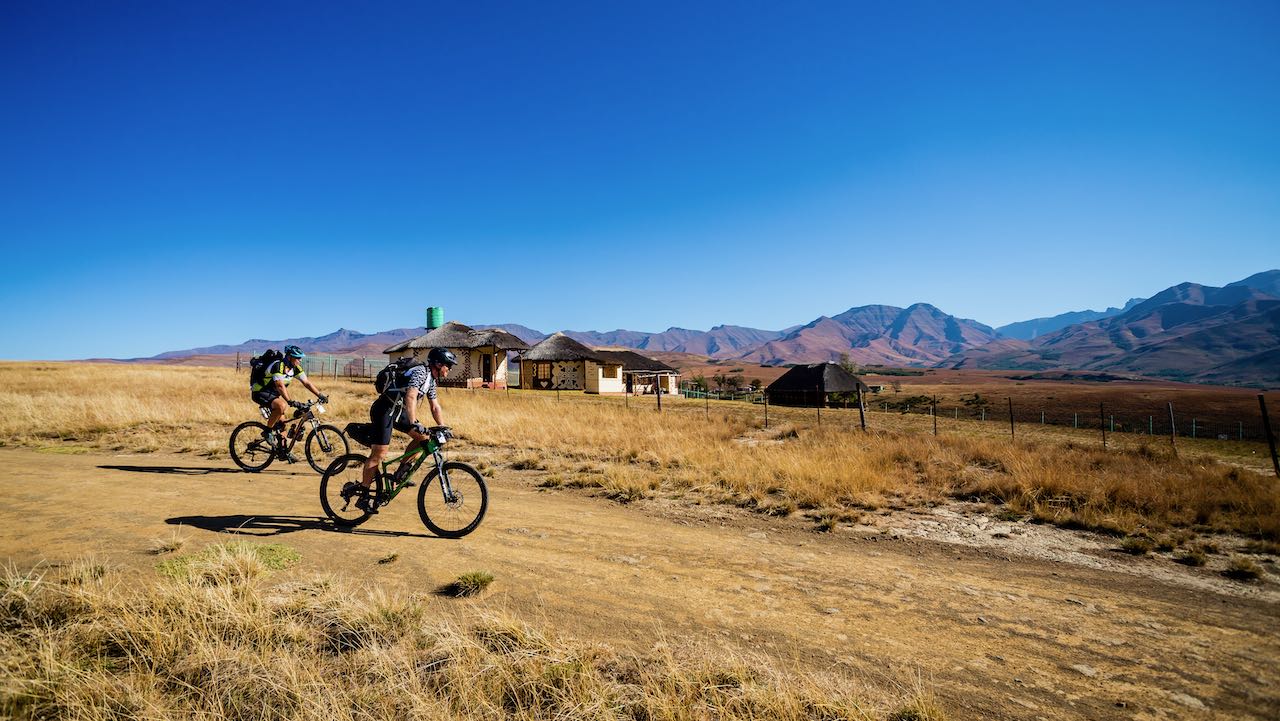
Coming to the realization that the extreme difficulties of the trail were actually quite desirable quickly and positively changed my perspective on the Freedom Trail experience. My fear of riding in the dark was transformed into a new challenge; the difficulty of hiking with my bike up sheer mountain slopes became an opportunity to overcome something really difficult; and I began to experience the pure joy of just riding in the most remote parts of South Africa. From that point onwards on the trail, I began to look forward to the difficulties that lay ahead as each represented a chance to learn, grow and engage more deeply with my surroundings. And there was no shortage of difficulties still to come. Having trudged into the second overnight support station, after 12 hours on the trail, just as the sun was setting on day 2, we woke up to cold rain on day 3. Setting out on our bikes in the predawn pitch black, with the raindrops clouding the light from our headlamps, and the cold biting through my gloves and socks necessitated that I seriously embrace the idea of desirable difficulties. By the time I reached the lunch stop at Glen Edward, I could no longer feel my feet or hands due to the combination of wet and cold. I peeled off my socks and gloves and lay on my back with my hands and feet stretched out to absorb heat from the farmer's anthracite heater in their living room, trying to thaw out. With some delicious soup in my system and some vague feeling back in my hands and feet, I set back out on the trail with my four other riding partners, who prior to the race I had never met, but with whom, due to this shared experience, I was quickly forming a strong bond. We made our way up and down mountains, through thick groves of wattle and across chilly rivers; we stopped for Coke and chips at a spaza shop in the absolute middle of nowhere and eventually, just as darkness was descending, we arrived at Masakala, a simple guest house in a rondavel in the middle of a rural African village.
The Masakala guest house was not fancy by any stretch of the imagination: two wooden bunk beds per room, a single bathroom for all the guest staying there to share, a small spartan dining area with a pine table and chairs, and a tiny kitchen from where our hosts prepared food. We got a basic, yet comforting meal of meat, potatoes, and spinach and as I crawled into a warm bed that night with a full stomach, lying under the heavy Basutu blanket provided by our host, it struck me how, when out on the trail simple things are transformed into wonderful pleasures. Most people who partake in the Freedom Challenge are relatively well off: we have (or have had) good jobs: we can afford nice luxuries like a meal out or time away at a hotel when appropriate; generally we don’t want for much. If required to sleep in a bunk bed, or share a tiny bathroom with multiple other people, or have a cold shower in any other circumstance we would probably complain, but when out on the trail, no one complains. In fact, these simple things become wonderful pleasures in the context of the Freedom Trail. On my way to falling into a deep slumber that night, I realized that I need to be more grateful for what I have; I need to spend less time complaining and more time appreciating the simple pleasures in my life. The trail was revealing to me these authentic truths.
The shorter day of riding on day 4 was a simple pleasure in itself, after 3 days of more than eleven hours on the trail, a day of only 8 hours was a treat. As was the sunshine when it eventually appeared that morning. We had set off in temperatures of minus 9 degrees centigrade before dawn, riding through frost ridden fields and floodplains. So when the sun eventually emerged from the east to warm things up and to reveal the beauty of the mountains surrounding us, the five of us were all extremely grateful, lapping up its rays like as though they were an addictive drug of sorts. The time ‘off’ at Malekgolonyane that afternoon was a treat: we sat on the patio in the afternoon sun, enjoying a Black Label quart or two, discussing nothing much that I can remember. Then suddenly we were awed by the arrival of the eventual winner of the race, Mike Woolnough. He had set out from Pietermaritzburg just 34 hours ago and covered the same distance it had taken us 3.5 days to cover. Mike dropped his bike on the front lawn, ate a quick meal, shared some wild stories from riding through the night, took a 15-minute nap and within 40 minutes of arriving at the support station he was back on his bike, heading for Rhodes. As he left, the five of us looked at each other, shell shocked by what we had just seen. The endurance, resilience, and commitment of these top racers is something we struggled to fathom and comprehend. Seeing it in person made it even more unbelievable than just hearing about it.

On paper, day 5 looked quite easy; only 60 kms of distance to cover with some nice single-track descents along the way; lots to look forward to I thought. I was taken aback when one of the experienced riders in our group said we should budget 11 hours “What? That's not what the navigation narrative suggests and that’s less than 6km per hour” I argued. Lo and behold, he was right! Even though there were some epic single-track downhill sections that had all of us whooping and hollering, there were also some long, hot, difficult climbs through remote valleys and some really tricky, un-rideable descents off nothing less than a cliff face. So in the end, the eleven-hour prediction was pretty much spot on. At 4 pm we arrived at Vuvu, the overnight stop that is “famous” for its bucket showers, and home accommodations. We gathered at the local school where we got food to eat and hot water in buckets to shower. Then at around 7 pm, we were introduced to our local hosts who took us to their homes to sleep for the night. While I was skeptical and a little nervous of invading another family’s home, I was made to feel extremely welcome and comfortable, and I ended up having the best night of sleep of the whole trip - a simple, yet extremely enjoyable pleasure.
That good night of sleep was a godsend because, on the final day of the race, the major obstacle is Lehana’s Pass, one of the revered and highly feared sections of the Freedom Trail. Almost every person who has done this section of the Freedom Trail has a ‘Lehana’s story’. It is a historic donkey trading route up to Naude's Nek, the third highest point in South Africa. To state that there is a ‘route’ up Lehana’s is a gross overstatement. It’s just a very, very large mountain that one needs to scale with a bicycle. The so-called ‘route’ up is approximately 8.4 kilometers and takes at least 5 hours; assuming you get the navigation right (which many do not). The history of the race is littered with legendary stories of people getting stuck and lost on Lehana’s. Luckily by this stage of the race, I had come to seriously embrace the idea of ‘desirable difficulties’, and I was lapping all the ‘simple pleasures’ that the trail had to offer. The views as we scaled Lehana’s were nothing short of exquisite, the higher we ascended the further we could see; as we neared the pinnacle is felt like we were on top of the entire Drakensberg range. It was an effort just trying to take it all in. On reaching the summit, one of the members of our group reminded us that it was Father’s Day and all of us had a sentimental moment thinking about our families as we sat atop the world. The descent down to Rhodes from there was pure joy, as was the feeling of finishing this magnificent event. Yet the joy of finishing was coupled with more than just a tinge of real sadness to have to leave the trail and go back to real life. Yet the lessons of the trail are so important in real life: the lessons that difficulties foster learning, engagement and growth and that appreciating the simple things can create a whole new perspective. What more could I learn, I wonder, if I tackled the entire 2300 km of the Freedom Trail from Pietermaritzburg to Wellington, in the Race Across South Africa?


